

Backyard Home (ADU) Blog
This blog provides the information needed to plan your backyard home project and build an ADU on your property. We cover everything from financing to eligibility to construction.
Big News for Housing in Maine: LD 1829 Signed into Law!

Backyard ADU’s 525SF S-Line ADU design path
UPDATE 2/17/2026
Since we first published this post, a few parts of LD 1829 have been clarified through ongoing implementation guidance.
One that matters for ADUs is fire safety: a town can’t require sprinklers for an ADU unless it’s within, or attached to, a structure that has more than two dwelling units (including ADUs).
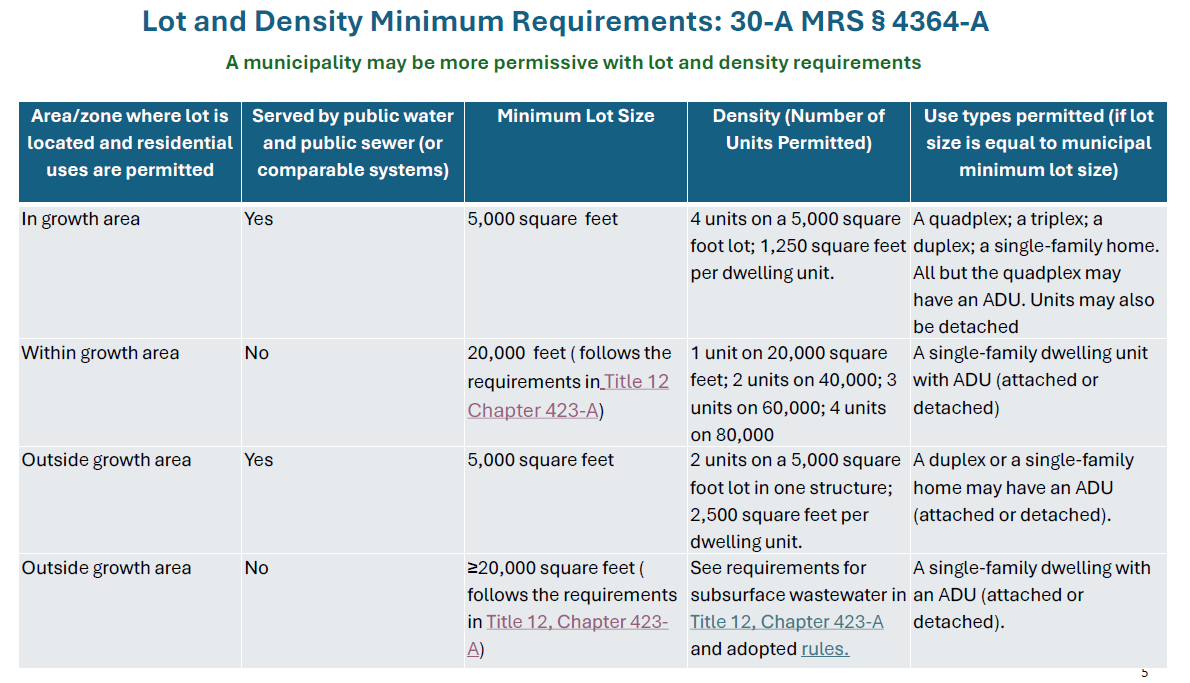
On the zoning side, many of the real questions now are about the minimum lot size and density standards towns must meet for “multiple dwellings on a lot,” especially where the rules differ based on whether a property is in a designated growth area and whether it’s served by public water and sewer (or comparable systems). See updated table below.
More information can be found here.
2025
We’re celebrating a huge win for housing in Maine—LD 1829 was officially signed into law by Governor Janet Mills! This legislation is a powerful follow-up to the landmark 2022 law, LD 2003, which legalized accessory dwelling units (ADUs) statewide and began the long-overdue process of zoning reform across Maine.
LD 1829 builds on that progress with clearer, stronger rules that make it easier to build ADUs and multifamily housing, while reducing red tape for homeowners, builders, and municipalities alike.
Here’s what’s in the new law—and why it matters:
No More Sprinkler Requirement for Most ADUs
Municipalities can no longer require fire sprinklers for ADUs unless the structure contains three or more total units (including the ADU). This is a game-changer, especially in cities like Portland, where sprinkler mandates were making ADUs financially unfeasible. It’s a win for affordability, flexibility, and common sense.
More Homes Allowed on Residential Lots
Municipalities must allow at least three dwelling units as a use on any lot where residential use is permitted, and up to four units in designated growth areas or on lots served by both water and sewer. However, the actual number of units allowed will still be moderated by town rules about lot size, density, frontage, and other dimensional requirements, some of which are also governed by LD1829.
This change opens the door for small-scale infill development, which can add gentle density while preserving neighborhood character.
Smaller Lot Sizes in Urbanized Areas
Minimum lot sizes in areas with water and sewer are now capped at 5,000 square feet, removing an outdated barrier to building more homes in walkable, connected places.
ADUs Are No Longer Limited to Single-Family Lots
LD 1829 clarifies that ADUs can also be added to lots with existing multifamily housing, not just single-family homes. This broadens the scope of where ADUs can be built and maximizes their potential as a tool for housing access.
Owner Occupancy No Longer Required
One of the most significant updates: ADUs must be allowed even if the owner doesn’t live on the property. This change invites more investment, supports rental opportunities, and gives property owners more flexibility in how they use and finance their land.
More Room for Affordable Housing
The bill also revises subdivision laws, increasing the threshold from three to five units before triggering subdivision review. This allows small-scale affordable housing developments to move forward with less delay and lower cost.
When Does the Law Go Into Effect?
Municipalities with a city-council form of government have until July 1, 2026 to implement changes to their ordinances. Municipalities with a town-meeting form of government have until 07/01/2027.
At Backyard ADUs, we’re thrilled by this legislative victory. It’s a critical step forward for flexible, attainable, and sustainable housing across Maine. If you're a homeowner, builder, or policy advocate looking to understand how these changes affect your community—or your property—get in touch. We're here to help.
Liz Trice – Partnerships Director, Backyard ADUs
#MaineHousing #ADUs #HousingAffordability #SmartGrowth #ModularHomes #FireSafety #PolicyMatters
Liz Trice brings a strong background in community development, policy advocacy, and coalition-building to her role at Backyard ADUs. With a passion for housing innovation and local empowerment, she works to bridge the gap between municipalities, nonprofits, and private partners to advance sustainable ADU development across New England. Liz is committed to creating collaborative solutions that expand housing options while preserving community character. At Backyard ADUs, she leads strategic initiatives that help towns unlock funding, navigate zoning reform, and build programs that serve real people in real neighborhoods.

Maine report points to Modular to save on Housing Costs

Maine's ambitious goal to construct over 80,000 housing units by 2030 necessitates innovative approaches to enhance affordability. A recent analysis commissioned by the Maine Affordable Housing Coalition and written by Sarah J. Sturtevant, titled "Field Notes II: Can Construction Technology Improve Affordability?" interviewed over twenty people representing developers, suppliers, manufacturers, contractors, designers, and regulatory groups, and asked, “Might greater adoption of new(er) construction technology bridge the gap between construction costs and what most Maine households can afford?” The answer is a qualified “yes”. Newer methods can reduce costs, and there are barriers to address.
The Advantages of Modular
Sturdivant investigated the potential of three technologies: uninsulated exterior wall panels, insulated panels, and modular construction, to reduce the cost of housing in Maine. She concluded “Modular components have the most promise and the most barriers. Depending on whether the state is able to reach a higher level of standardization, Maine could see cost savings of 10-35% of total costs from the greater utilization of modular.” Benefits of modular include:
Quality and performance from building in a controlled environment
Better utilization of Maine’s workforce
Less seasonality
Faster
More ergonomic construction for workers
Less waste going to landfills
She adds, “Barriers are extensive, including the same code-enforcement issues as insulated-panel construction; double sales tax is charged on modular units and the licensing requirements have not coordinated with training programs resulting in lack of human capacity. Overall, there is a lack of industry knowledge about the opportunity of factory-built components … New(er) technology is an important tool in the tool kit and it is worth addressing the remaining barriers to broaden adoption.”
“Root Causes” Why is it so hard to build lower-cost (aka affordable) new homes?
In the “Root Causes” section of the report, the writer points out that:
There are dozens of organizations (public and private) that impact the construction of a single home, each with a different funding source and business model.
Each new development is virtually its own company, which is inefficient
On average 24 subcontractors touch each new single-family home over the year it takes to build, and it’s expensive to coordinate so many people.
Multi-family has an even higher number of “subs” and takes closer to 2 years of construction, and over 3-5 years of permiƫting & approvals.
Coordination also includes surveying and engineering, title work, legal and accounting, distributors, transportation, earthwork, and repairing heavy equipment.
There are shortages in the number of contractors and subcontractors, and shortages of workers, and the educational system tends to focus on training employees, not on creating new companies.
By some measures, over 40% of total development costs are from increased regulatory burdens over time
Maine overall has a high percentage (about 30%) of 1 person households, and it’s challenging financially to build for one person households.
Recommendations for Maine
Here are some of the solutions the author suggests; for a full list see the link to the document below.
Establish a repeatable floorplan that could be the basis of a state-wide modular contracted garnering volume pricing and expedited reviews.
Ask the Real Estate board of appraisers to study valuation methodologies for small homes
Suspend the finished goods sales tax on modular manufacturing, so that materials aren’t taxed twice.
Clarify and train for interaction between code enforcement, factories, and third-party inspectors (TPIs)
Shift the Manufactured Housing Board to the Maine Office of Community Affairs
Increase the threshold size of projects that require no additional review
Shorten approval times
Train more students who want to enter the trades
Create business development programming for tradespeople who want to start their own companies.
For additional reading and more information the full article can be found at: https://mainehousingcoalition.org/wp-content/uploads/2025/01/Field-Notes-II_Can-construction-technology-improve-affordability-1.7.25.pdf